The Why
Considering your impact
To engage your viewers meaningfully is expected that you consider certain things as an artist:
Responsibility
Impact
Infrastructure
Community
Narrative
You can commission a massive structure that means nothing, or you could hang some fabrics on an alley in a way that inspires viewers to engage with their surroundings
Understanding your why will help when navigating difficult financial and logistical challenges
As Olafur Eliasson has said Art is not the object but what the object does to the world
Art is a Conversation
Art and the artist are not defined exclusively by their material output, you're finding your position inside the conversation
The conversation between crafters from the past that inspire you, your present team and the future spectators
Trying to go at it alone robs from you the opportunity of participating in the conversation and increases the amount of things that can go wrong unnecessarily
All of your drafts, scribbles and the road you take to the destination are part of the conversation
As Ai Weiwei has emphasized repeatedly, public art inevitably exists inside political, social and institutional systems. You don’t escape them. Is better to engage them consciously
A Good Mindset
While we encourage a degree of recklessness and risk taking, we know that is more sustainable to work with courage and structure, spreadsheets and clear timelines
Having a good mindset and a clear view of your budget, audience, technical knowledge will help you articulate your vision to potential collaborators and financial backers
There are many possibilities at every step, and many things that can go wrong
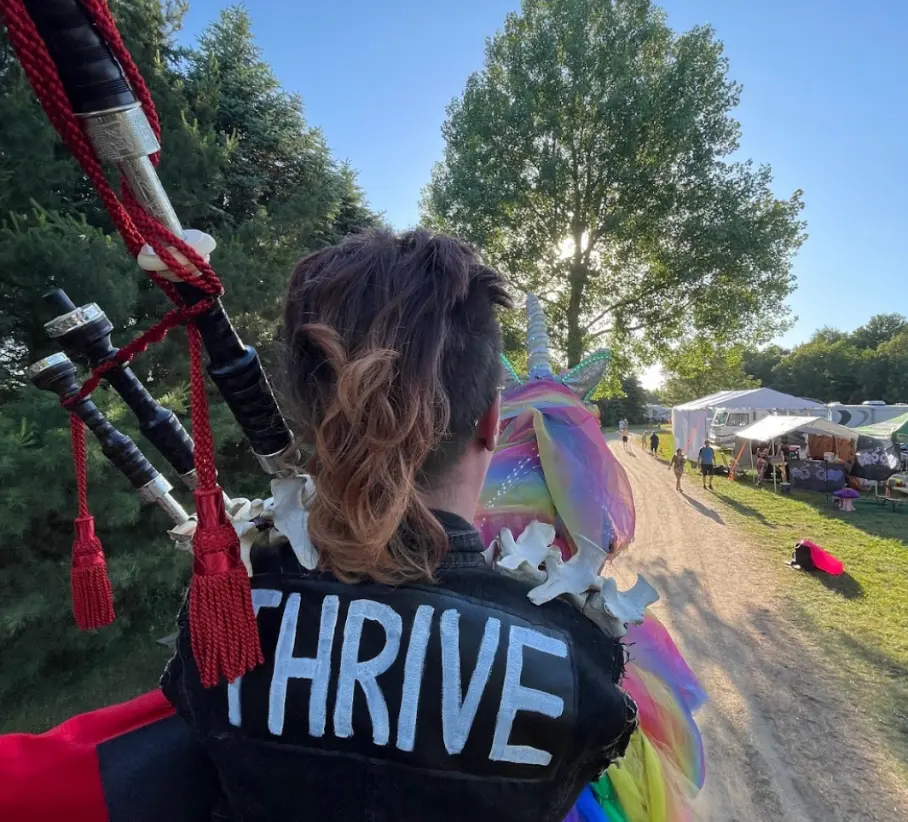
A bagpiper riding a massive unicorn art car, Lakes of Fire 2023
Self-Funding or Grants
Is great when you can just go and buy everything and fund your own project, but when that's not the case, consider there are many ways to generate revenue from crafts and events
As your project develops, you need to consider cash flow, to cover for unavoidable operational expenses
Understanding your why and committing to it is investing in yourself
Look into your short term and long term plans and create roadmaps that will keep you busy for years, building larger projects every few iterations
When fundraising via crowdfunding, grantwriting or corporate sponsorhip your why must look like it is aligned with the objectives of the supporters. There are many layers to it, but in general is important to be able to articulate your personal mission and the goal of the proposal to be seriously consider for receiving money
“I want to express myself at a large scale”
Lame
“This installation will activate underused public space, engage 200 local volunteers over three weeks, and include free educational workshops aligned with youth arts programming”
Much better
Particularly when it comes to grants or corporate sponsors, there's usually is a history of previous awardees that can help your research and tailoring the description so it feels aligned
During your creative research process include time to look into business models, warehouses, artists lofts, collectives, hot dog stands. artists like Theaster Gates have built entire ecosystems by aligning artistic vision with civic redevelopment and community goals
It is important that you're comfortable requesting this money, we have friends pitching expensive productions comfortably as well as people who prefer to recycle cardboard before cursing themselves by being in the same room with people who shower; we love them all, is up to you and the boundaries and sacrifices you'd make for your art
Fundraising is emotional, understanding your why is important to stay motivated and consistent in a process that includes being rejected. As Shepard Fairey has discussed in relation to large public campaigns, messaging clarity is everything. If people cannot explain your project to someone else, they will not advocate for it
Decision Point: Scale and Responsibility
Consider whether your project is small for a few friends, or whether you need to have 200 volunteers to cover all the shifts; for most large projects you need to think on terms of years, as it might take an arbitrary amount of time to develop certain skills, receive permits, develop prototypes and safety protocols
Supporting your decisions with research gives everyone involved more confidence on the project. Consider reading more about artists whose work you like, read interviews, investigate their process, see if they mention their systems
Developing your why
We recommend thinking about three versions, and revisiting as you grow
Private notes that are your personal driver
Public like the version that would go on your instagram profile
Institutional for grant writing and promotional material
Journaling Prompts
Why do I want to build?
What is art that has impacted me?
What impact can I have with my art?
Would I still do this if no one where to see it?
Why am I doing this now?
Would I sacrifice hours of sleep for this?
Forum Discussion Prompt
Post your Public Why in 3 to 5 sentences
Take Action
Find any past or open grant opportunity, corporate sponsorship or public commission, and write your why again aligned with their intents
There are no comments for now.
to be the first to leave a comment.